Insight Digest | Issue #10
In Insight Digest, we showcase the latest happenings in science research.Seeing entanglement in a cuprate spin chain
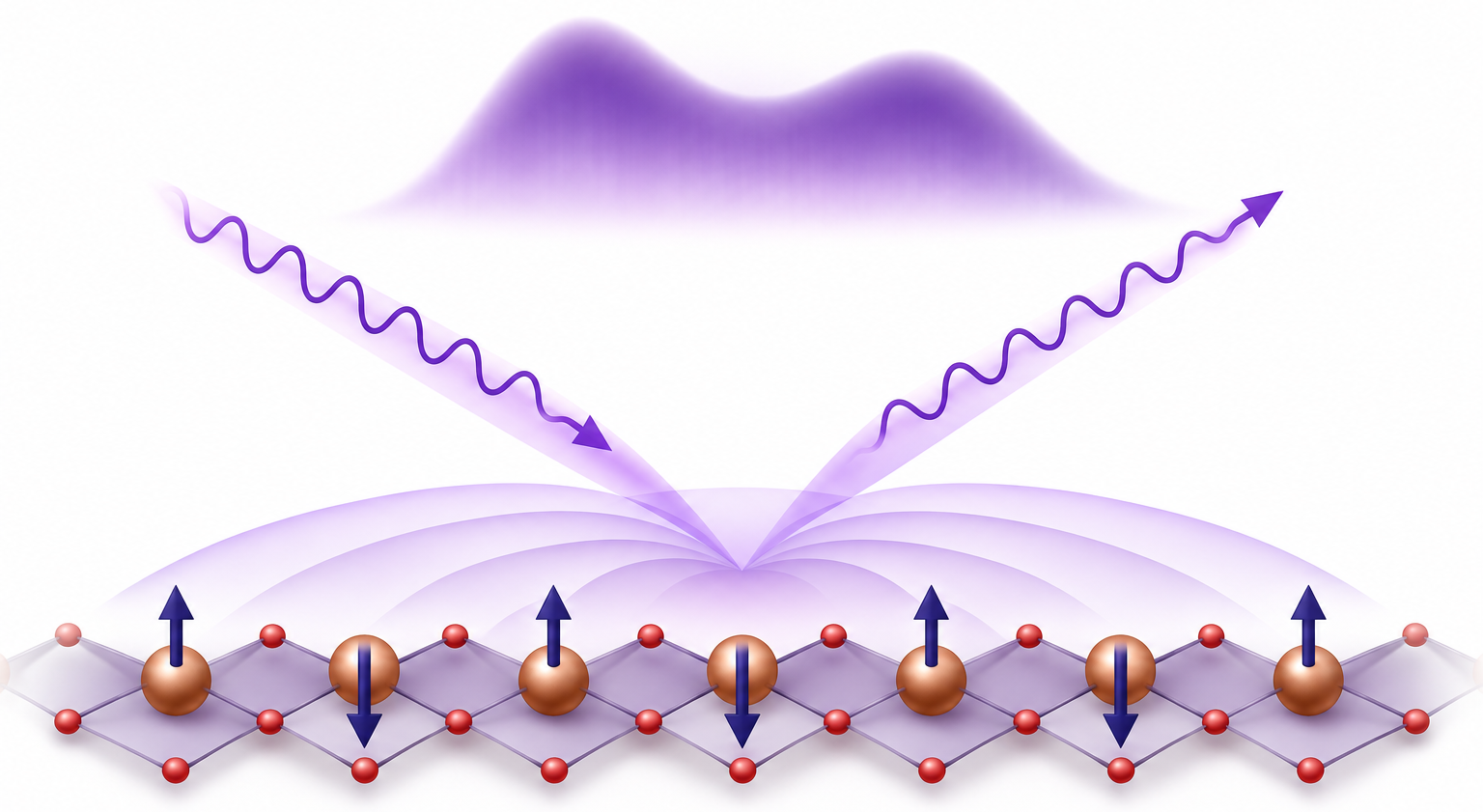
S. F. R. TenHuisen et al., arXiv:2609.08134, Sept. 08, 2026 (Department of Physics & Astronomy, Seoul National University) Subjects: strong-correlations, entanglement, materials-scienceEntanglement is one of the distinguishing features of quantum mechanics and a core aspect of modern quantum condensed matter physics. Many of the interesting phenomena seen in the so called quantum materials bear their origin to intricate patterns of entanglement between the constituent particles. Yet, it is difficult to quantify entanglement measures in the laboratory: reconstructing a many-body quantum state requires measuring an exponentially large number of observables because of the exponential growth of the Hilbert space seen in systems of interacting particles. In this work, TenHuisen and colleagues ask whether resonant inelastic X-ray scattering (RIXS), a widely used probe of excitations in correlated materials, can instead witness entanglement through what’s called an entanglement witness. Entanglement witnesses are quantities that are not as powerful as entanglement measures – they can detect whether a state has entanglement but cannot quantify the amount of entanglement. But their main advantage is that they can be experimentally measured. For example, in this work, the authors probe the quantum Fisher information (QFI) – an entanglement witness that can be linked to a dynamical spin structure factor. The spin structure factor roughly quantifies how likely it is that a system will be excited by a specific energy through a specific spin-flip process.
Their test case is Sr2CuO3, an insulator with strong magnetic interactions. It turns out that its low-energy state is quantum critical, which essentially means that the correlations within it span long distances. The low-energy excitations fractionalize into spinons, which means its quantum numbers are fractional. These long-range quantum fluctuations make the chain a promising place to find deep spin entanglement—and a well-characterized setting in which to test a new measurement protocol.
As mentioned, the authors use QFI to probe the system. For a spin- system, the QFI per spin above a value certifies entanglement involving at least spins. The challenge is that RIXS intensity is not simply the spin structure factor: in an interacting many-body system, other processes always contribute. The work calculates the appropriate spin structure factor by combining the experimental data with theoretical calculations of relevant models using exact diagonalisation and density matrix renormalisation group (DMRG). At 35 K, the momentum-resolved QFI peaks at a value exceeding six, witnessing at least seven-partite spin entanglement. At 220 K, the witness remains above four near specific directions in momentum space, still certifying entanglement among at least five spins. The result shows that substantial multipartite correlations survive well above the lowest measurement temperature, because the chain’s large exchange scale keeps it in the quantum regime.
This is a first demonstration of RIXS as a probe of multipartite spin entanglement in a solid. The inference depends on a material- and geometry-specific, theory-assisted mapping from RIXS intensity to the spin response, so it is not yet a model-free measure. Even so, the method opens a path toward testing entanglement in less tractable materials.
The Wandering Mind: When Our Thoughts Steal Our Attention!
Welhaf MS, Banks JB. J Exp Psychol Learn Mem Cogn. 51(2), 238–254 (2025) (PhD Scholar, DBS, IISER Kolkata) Subjects: Attention span, task related thoughts, sustained attention-to-response task, valence, psychologyDid you ever end up planning for a holiday trip or pondering about an unpleasant scenario while completing an important task of yours? Now, that is termed as ‘mind wandering’: when our attention shifts from an ongoing activity towards any unrelated thoughts. This ignited some minds to ask whether the emotional nature of thoughts (negative, positive or neutral) affect our attention?
Keeping in mind that ‘mind wandering’ is generally associated with reduced task performance, a group of researchers carried out a simple yet interesting study to investigate whether negatively, positively and neutrally valenced task-unrelated thoughts (TUTs) have different relationships with sustained attention(Maintaining focus on a specific task over an extended period). They also noted whether these different types of thoughts become more frequent as a task progresses.
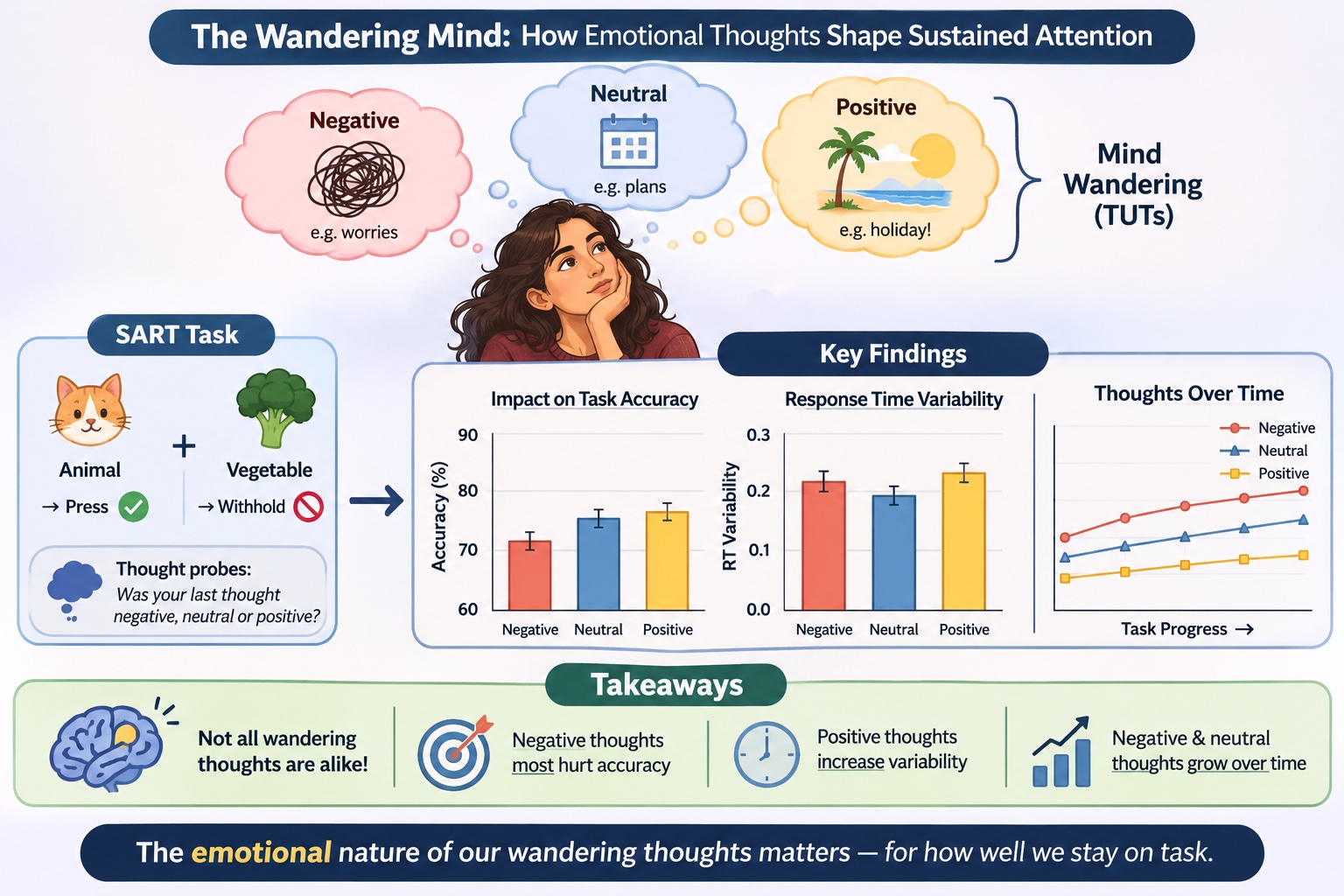
For the study the researchers pooled and analysed six datasets collected across several years involving participants aged 18-35 years, out of which most of them were university students. The participants were asked to perform a sustained attention-to-response task (SART):i.e.,’to press the spacebar for animal words, but withhold the response for rare vegetable words. And at random intervals,the participants were interrupted with thought probes asking them to categorise their immediately preceding thoughts as positive, negative or neutral. The researchers compared these reports with measures of response-time variability (refers to how much a person’s reaction time fluctuates from one to another during a task or how consistently or inconsistently someone responds) and task accuracy, using meta-analysis, and examined changes in thought frequency across successive task blocks.
The findings of the study revealed something intriguing: ‘mind wandering’ is not a uniform phenomenon and varies with the emotional content of our thoughts.Both pleasant(positive) and unpleasant(negative) thoughts can divert our attention from an ongoing task, though their effects may manifest differently.
Negative thoughts may particularly disrupt the accuracy, while positive thoughts may contribute to fluctuations in response consistency. The researchers also found an increasing occurrence of neutral and negative thoughts over time (while doing the task).
This research concludes by focusing on the point that ‘mind wandering’ isn’t only a matter of losing focus, the emotional nature of our wandering thoughts may also affect the consistency and accuracy of the attention we pay to do a task.
When Rivers Flow Through the Sky: Atmospheric Rivers and the Changing Face of Global Rainfall
Pradhan, S., Wasko, C. & Peel, M.C. npj Nat. Hazards 3, 68 (2026) Subjects: Atmospheric Rivers, Atmospheric Moisture Transport, Precipitation Variability, Extreme Precipitation, Climate ChangeAtmospheric rivers (ARs) are narrow corridors in the atmosphere that transport large amounts of water vapour towards the mid-latitudes. When they reach land, particularly in coastal and mountainous regions, they can produce heavy rainfall and flooding. Although their importance is well established, their contribution to changes in average and extreme precipitation has not been examined consistently at the global scale. This study investigates changes in AR frequency and related precipitation between 1980 and 2019.
The authors combine precipitation estimates from the MSWEP V2 dataset with atmospheric river records derived from MERRA-2 reanalysis. To avoid relying on a single definition of an atmospheric river, they compare three detection methods. Rainfall occurring on a day when an AR is detected at the same grid cell is classified as AR-induced. Extreme rainfall is identified using a peaks-over-threshold approach based on the 90th percentile. Trends are estimated using Sen’s slope, and their significance is assessed with the Mann–Kendall test.
The results show that atmospheric rivers are major contributors to year-to-year precipitation variability across many mid-latitude regions. In parts of North America, western Europe, southern South America, southern Africa and Australia, AR-related precipitation explains more than 70% of this variability. The study also finds an increase in AR frequency at mid-to-high latitudes, alongside decreases in some subtropical regions. The increase is particularly evident over parts of the Southern Ocean and North Atlantic.
Both the frequency and magnitude of AR-associated precipitation have increased over the study period. The rise in AR-related extreme rainfall is especially apparent near landfall regions, including parts of northeastern North America, Brazil, western Africa, the Mediterranean coast, Japan and southeastern China. Here, concentrated moisture transport can interact with terrain and weather systems to produce intense rainfall.
The authors suggest that a warmer atmosphere, which can hold more moisture, and changes in storm-track positions may contribute to these trends. However, their method identifies rainfall and ARs occurring together; this does not, by itself, prove that an AR caused the rainfall. Detection algorithms also differ in the geographical extent of trends, although the main patterns are consistent across all three.
Overall, the study indicates that atmospheric rivers are becoming more important to precipitation extremes and flood risk. The findings highlight the need for water-resource planning and flood-risk assessments to account for changing AR activity. Further research is needed to distinguish the effects of atmospheric warming, circulation changes and natural climate variability.

When a Canonical Copper Transporter Takes on The Challenge to Detoxify a Toxic Heavy Metal: Cadmium
Bhattacharya, D., Chakraborty, K., Pandey, R., Maji, B., Bhattacharjee, A. & Gupta, A. FEBS Letters (2026) (Department of Biological Sciences, IISER Kolkata) Subjects: Metal homeostasis, cadmium toxicity, ATP7B, intracellular trafficking, lysosomal biologyImagine a protein whose primary responsibility is to maintain copper balance suddenly taking on the challenge of protecting cells against an entirely different toxic metal! This is precisely the unexpected cellular phenomenon explored in our recent study. Cadmium (Cd) is a highly toxic heavy metal that enters the body through environmental and occupational exposure. Unlike essential metals such as copper, cadmium has no known biological function in humans. Its strong affinity for sulfur-containing groups allows it to interact with cellular proteins, disrupt essential biological processes and cause damage to vital organs, particularly the liver and lungs. Although the toxic effects of cadmium are well recognised, how cells actively eliminate this metal remains relatively poorly understood.
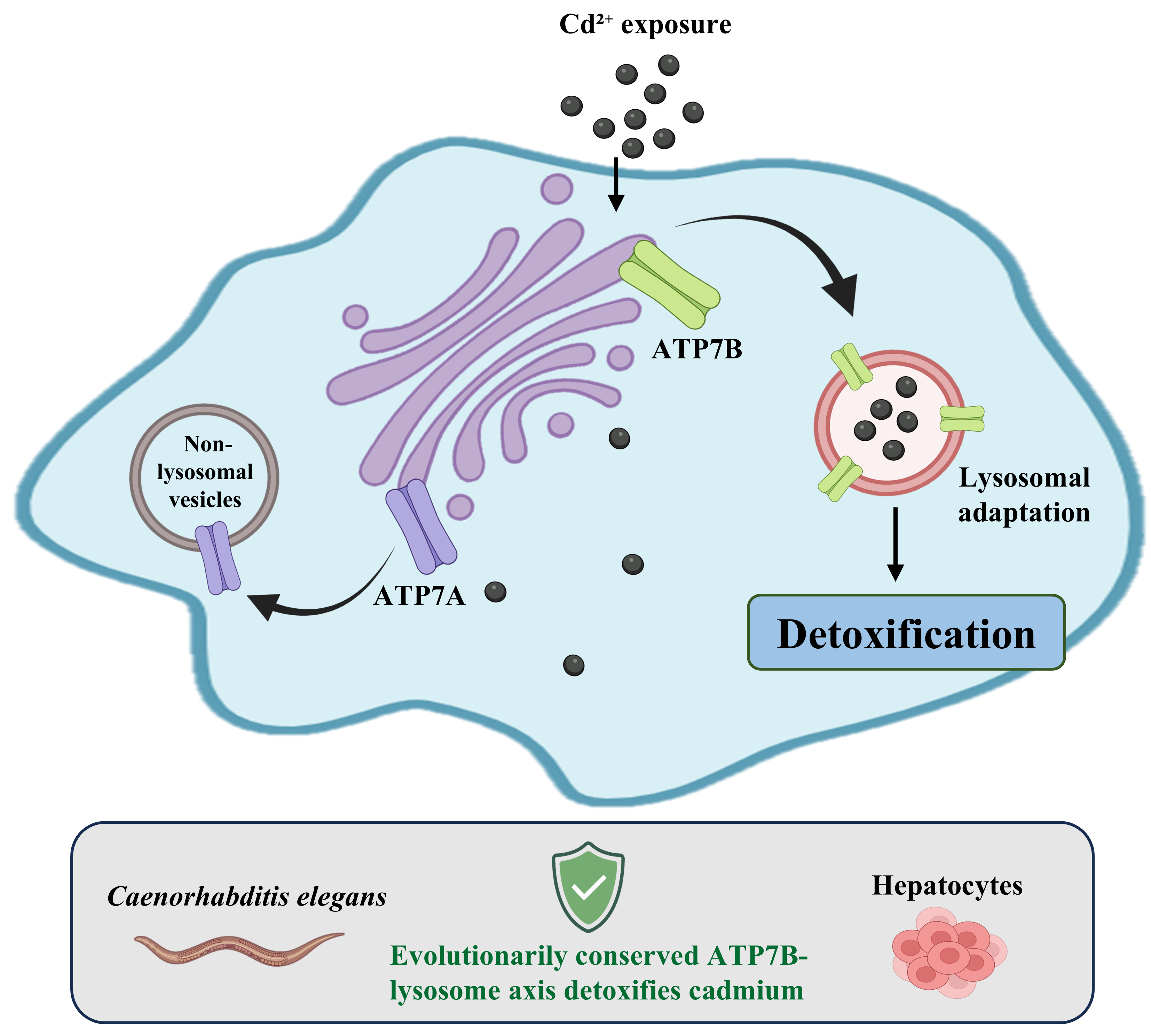
Our research investigated whether two closely related copper-transporting proteins, ATP7A and ATP7B, could contribute to cellular cadmium handling. These proteins are best known for maintaining copper homeostasis by transporting excess copper across cellular compartments. Interestingly, we discovered that ATP7B has an unexpected role in cadmium detoxification. In response to cadmium exposure, ATP7B undergoes a remarkable change in its intracellular location, moving away from the trans-Golgi network (TGN), where it normally resides, towards lysosomes. Lysosomes are membrane-bound organelles traditionally recognised as the cell’s recycling and waste-disposal centres. Cells do more than just move ATP7B around. They also make lysosomes more acidic. This might be the cell adapting so that the transporter and lysosomes team up for getting rid of cadmium. Cells without ATP7B were worse off when exposed to it. That part stands out because it shows how important the protein is for protection.
ATP7A was different, though. In lung cancer cells, it moved around after cadmium but stayed away from lysosomes. Maybe different cells have their own ways of handling it.
The same kind of protection showed up in worms when things went wrong with lysosomes or the ATPase. It could be an old mechanism that stuck around. There is still a lot that needs figuring out, though.
This connects metal transport to lysosomes in a way that was not seen before. It changes how people think about ATP7B since it is not just for copper anymore. Cells seem to reuse their trafficking for dealing with stress from metals.